


Six themes constituting good mental health in people with ID were derived from the data: (1) physical health, (2) working and living environment, (3) social contacts, (4) appropriate support, (5) competencies, and (6) psychosocial functioning. Psychosocial functioning was the richest theme, it was therefore split up into five sub-themes: (6a) emotions, (6b) self-determination and self-concept, (6c) doing something meaningful, (6d) responding well in social situations, and (6e) having energy and being able to relax. The coding tree is depicted in Fig. 2.

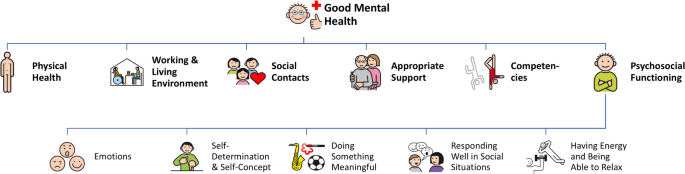
Themes and sub-themes of good mental health
Additionally, one side-theme was identified: confusing mental health with mental illness. When first asked about their associations with good mental health, many participants’ responses revolved around aspects of mental illness. They talked about different mental disorders and their symptoms. Moreover, various treatment options were discussed (e.g., taking medication, seeking the help of a psychologist/psychotherapist, visiting or calling counseling services). One participant stated that.
“Mental health is, for example, when I have serious problems, that I go to a psychologist and talk about all my problems, […] like what’s bothering me or weighing me down, and maybe, I don’t know, get some advice or tips, like what I can do about it and so on.” (participant 8).
Physical health
Different facets of physical health such as sleep, nutrition and doing exercises are crucial for mental health according to the participants. “Sleeping well is healthy” (participant 4). Having good sleeping-habits, including the choice of when to go to bed and when to wake up, are important aspects for recovery and being in a positive mood. However, disturbed sleep can be due to unresolved issues. One participant described: “yes, when something is really bothering me […] […] it keeps going around in my head forever, and then I can’t fall asleep […] then I’m not feeling well again.” (participant 8). The participants reported that healthy eating habits and a balanced diet with vitamins and fibers are equally important for mental health. Enjoying food and drinks is not only a source of physical nourishment but also provides moments of enjoyment and relaxation, contributing positively to mental health. Engaging in sports can promote both physical and mental health as stated by the participants: “Moderator: Would you say that sports also help with your wellbeing? That it’s good for your mental health as well? Or does sports only help the body? Participant 2: It helps me feel good.” Also, moderate activities, like walking, offer valuable mental health benefits such as calming the mind and organizing thoughts. Regular preventive medical check-ups and the use of necessary medication enable long-term mental health and a sense of feeling good.
Working and living environment
Having and getting a job, whether in a sheltered workshop or another setting, and a positive working environment, including good relationships with colleagues, promotes mental health through aspects such as earning money and social connections. Participants reported on specific strategies for responding to needs and emotions during work to directly communicate and maintain health: “we have a mood barometer at work, where we are supposed to write down how we’re feeling each day” (participant 10). One participant stated that “if you feel bad, you can talk to us [caregivers] anytime” (participant 11).
How individuals feel about their living environment has a significant impact on their mental health. One participant expressed satisfaction with the situation:
“We’re happy with our [supported living] apartment. We’re doing well. […] I enjoy it. I don’t have any problems.” This participant also emphasized the value of home: “home is where it’s the nicest” (participant 2).
The need for personal space, privacy, and the ability to withdraw when necessary are essential for maintaining mental health. One participant shared their frustration regarding a lack of privacy, stating, “participant 9: „my sister walks in every time […] and is always listening when I’m talking to someone on the phone.” This illustrates how constant interruptions can lead to a feeling of discomfort and personal space being invaded. Another participant pointed out a strategy for dealing with noise: “If it’s too loud, I go to my room.“ (participant 15).
Social contacts
Participants emphasized the importance of social interactions and the impact of others on one’s mental health, with one participant suggesting that others should “not make fun of him [Konrad, the person in the case study], [and] encourage him” (participant 6) so that he can believe in his abilities and not feel like a failure. Community integration through shared spaces in assisted living facilities helps to counteract loneliness, joint leisure activities foster inter-connection. Being connected to others encompasses various forms of support, including visiting services for elderly people, colleagues at work, and positive relationships with professional caregivers. These connections involve being understood and having the ability to talk to others. Engaging in conversations about problems with support persons and participating in group leisure activities, further enhances these connections and contributes to one’s mental health.
The aspect of being close to others delves deeper into the quality and intimacy of relationships. This involves cultivating strong friendships and family ties that provide emotional support. The ability to discuss personal matters openly with friends contributes positively to mental health. Additionally, love and romantic relationships provide an essential element in promoting emotional proximity and mutual affection, with one participant noting: “Love is also part of health for me.” (participant 15).
Family relations reinforce emotional support through regular visits, shared activities and physical closeness. Many participants emphasized the importance of hugs for emotional comfort: “What’s also important, is hugs to make me feel better. […] From my sisters, my nieces and nephews. From my aunt. Basically, from the whole family.” (participant 7). By offering company and opportunities for physical activity, such as walking the dog or horse riding, also pets contribute to emotional wellbeing, providing comfort and security.
Appropriate support
Appropriate support encompasses emotional, practical, and social assistance tailored to individual needs. Emotional support means receiving reassurance and “comforting each other when someone is feeling down.” (participant 6). Meaningful examples are “when she [caregiver] notices I’m not doing well, she hugs me, and that really helps me.” (participant 10). Practical support involves assistance with daily tasks like “[…] helping out around the house. Taking care of the animals […] taking out the trash and changing the bed linens […]” (participant 2). Another participant stated, “I always get a bath at the weekend.” (participant 15) and linked this to feeling good. Participants indicated training to enhance independence, as well as the provision of assisted and alternative forms of communication as further facets of practical support. Moreover, financial support from family members (e.g., to pay for therapy sessions) was valued by the participants. Giving and receiving support (e.g., from friends, family, caregivers) contributes to a sense of mental health. Participants emphasized that they are “helping each other” (participant 7), another one shared: “I enjoy supporting people […] so they can have a sense of wellbeing and mental health.” (participant 3).
Asking for support is crucial to being mentally healthy: “Get support, have a conversation. You need that to stay healthy too.” (participant 12). While it is essential to “talk to your caregivers and ask them to help you” (participant 11), it can be embarrassing or difficult. However, one participant expressed the importance: “I have to dare, yes, I need the support, because if he never gets support because he doesn’t dare, then he will always fall by the wayside.” (participant 12).
Moreover, appropriate support was the only topic where the participants figured that there are differences between our fictional cases Konrad, with low functioning levels, and Klara, with high functioning levels. While the participants noted that Konrad and Klara share the same needs regarding their mental health, they concluded that Konrad and Klara have to be provided with different levels of individualized, needs-oriented support, in order to do so.
Competencies
To learn basic competencies such as reading, writing and calculating enhances mental health according to the participants: “Participant 15: I can read incredibly well, I spent hours reading at my parents’ place. Moderator: Is that also something that makes you feel good? Reading? Participant 15: Yes.” Furthermore, skills of mobility, using public transport, getting around on your own were mentioned. Competencies also include being able to do activities of daily living independently (e.g., house keeping, cleaning, grocery shopping). One participant expressed pleasure: “What I enjoy is cooking a lot and always cleaning the kitchen” (participant 10).
Establishing routines and waking up early for work, is a way to feel comfortable; for example, one participant noted, “I always get up at 5 o’clock. That’s the norm for me” (participant 18). Learning about health, including first aid and knowing how to call emergency services, empowers individuals and contributes to mental health.
Psychosocial functioning
Psychosocial functioning was the richest theme with five sub-themes.
Emotions
Emotional awareness and regulation play a central role in psychosocial functioning for mental health, as participants emphasized in mood, feelings, and coping strategies. It’s not just about feeling consistently happy, participants also noted experiencing a range of emotions (e.g., anger, sadness, joy) and expressing them: “Participant 19: Crying. Crying. Moderator: Crying? Mmh. Crying also has something to do with the psyche? Participant 19: Yes (…) Also laughing. Moderator: Laughing too? Participant 19: Yes.”
Strategies to deal with emotions and feelings were also mentioned as a part of mental health, for instance: “I like watching animal videos when I’m angry.” (participant 11). However, difficulties with emotion regulation are also apparent: “Usually, when I’m angry or grumpy or something like that. I can’t completely control it, and then I might accidentally snap. Even if I don’t want to sometimes.” (participant 8). Participants also described dealing with loss as a component of emotion regulation: “My dad passed away before my mom. So, we were always at the cemetery. In the beginning, I would cry whenever I went there.” (participant 14). It was discussed that grieving became easier over time, when corresponding emotions are processed rather than suppressed.
Self-determination and self-concept
Self-determination and self-concept are relevant for participants’ sense of identity and mental health, encompassing aspects such as autonomy, independence, self-worth and confidence, and standing up for oneself. The participants emphasized the importance of independence, such as getting around using public transportation (see 3.5. competencies). The importance of freedom of choice was stressed, regarding decisions in daily life but also in the medical field, for example the choice of therapy. As one participant noted: “[I want to] decide everything for myself” (participant 5). Self-worth and self-confidence were discussed in the context of trying new things, like finding out what someone is capable of which in turn strengthened the self-confidence and a sense of self-worth. “Moderator: You said that she should try out what she can do? Why would that be good for her mental health? Participant 6: So that she feels more worthy. And self-confidence. That’s important.”
Another aspect is the ability to stand up for oneself, including talking about inequalities and communicating directly with others who do harm. One participant explained: “If something bothers you, you can speak up. Tell people. You don’t have to bottle up your feelings all the time.” (participant 11). Participants expressed the importance of setting personal boundaries, as exemplified “Yes, and when [first name] annoys me, I say, “Go away, leave me alone, I don’t want this.” (participant 9), as well as to defend oneself, and “I told him that I actually feel threatened by him because I don’t know what he wants.” (participant 11).
Doing something meaningful
Engaging in meaningful activities that provoke a sense of purpose and pride represent important facets of good mental health for the participants, whether in leisure or work settings (e.g., being a group-representative at your sheltered workplace). For instance, a participant shared: “Like [name of organization] I’m also a representative there, the deputy chairman. These are the important things where I say, oh, I have to work on that now.” (participant 12). Another one described value in setting personal goals: “I’m taking part in the [marathon] again next year. That’s important to me.” (participant 20).
Focusing on joyful leisure activities are characterized as beneficial. A participant reported the worth of fresh air and going on vacation with friends, family, or colleagues from work to describe the importance of being outside or in nature: “The air was so good for me there [on vacation]. I didn’t need a headache medicine that often” (participant 15). Participants figured that it helps to see a different environment, to be somewhere else, and not think about work. Trying out new activities was highly valued by people with ID, not only for its enjoyment as an influence on mental health but also in the context of fostering self-confidence and self-worth (see 3.6.2. self-determination and self-concept). Lastly, attending church was mentioned in a group of elderly participants as a meaningful activity.
Responding well in social situations
The ability to effectively solve problems and handle conflicts with others represents a part of social competence. Skills like deescalating conflicts, seeking the help of professionals (e.g., psychologists), expressing emotions and needs in case of conflicts were highlighted by the participants. Getting along with others was essential: “[…] understanding each other well. Getting along well with each other. And harmonize well” (participant 2). Empathy and understanding in considering the needs of others as well as taking the perspective of others contribute to mental health. However, it is equally important that others are considerate of people with ID and their learning difficulties (e.g., give them more time to complete a task) – “it’s important to respond to people’s needs and don’t just say ‘no, you have to do this because I told you so’” (participant 10).
Having energy and being able to relax
The participants also considered having energy and being able to relax to be highly decisive for mental health: “When I’m feeling good? Then I can tear down anything in my way.” (participant 12), and “[…] when I feel good, I want to do lots of things, I’m full of energy. I laugh a lot, make jokes, and am just in a good mood [laughing]” (participant 8). Having fun and laughing were mentioned as another aspect of mental health: “laughing a lot is healthy” (participant 19). Relaxation and avoiding stress were equally crucial. The importance of calmness and tranquility were emphasized: “for example, at the [swimming pool] or wherever, you can just lie down on the grass and simply enjoy the day” (participant 8) and the negative aspects of stress highlighted: “Stress is deadly, as far as I know” (participant 18). Other participants valued taking time for oneself to take a break and to calm down by explaining: ”When I’m not mentally or (…) overwhelmed, then I take some time for myself.” (participant 12). Likewise, it was discussed that motivation is essential, both through encouragement from others and because of personal interests. Being motivated by somebody to do (challenging) things is described as needed in some situations: “Yes, when someone motivates me to go to work, go to the doctor, or tackle challenges. […] Because sometimes I need that kind of motivation. So that I actually do something, you know?” (participant 3). On the other hand, aspects of intrinsic motivation such as having an interesting job or doing something that is close to one’s heart promote mental health as well as motivating others.
Prioritizing the most important aspects of good mental health
When asked for the most important factors for good mental health, the focus group participants concurringly prioritized (1) social contacts, especially regarding being connected to others, (2) doing something meaningful, (3) having energy and being able to relax, and (4) physical health.
link