


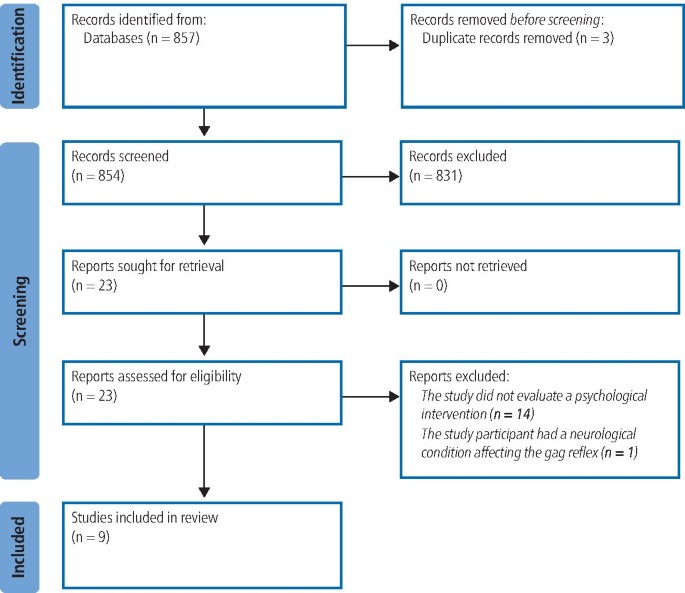
This scoping review was conducted in accordance with guidance from Mak and Thomas13 and prospectively registered on PROSPERO (CRD42024546940).
Eligibility criteria
The following criteria were used to consider studies for this review.
Types of studies
In this review, we included randomised controlled trials, quasi-experimental studies, case-control studies, and case studies examining a psychological intervention used to manage the gag response in dental settings. We excluded opinion pieces and ‘top tip’ articles.
Types of participants
Participants of all ages classified as having gagging of any degree of severity (assessed by any means) that impacted dental care were included. We excluded studies involving the following participants: i) those using any medications that might reduce the gag reflex; ii) those with any neurological condition; and iii) those with oral lesions or who have undergone surgery that might alter gag sensation.
Types of intervention
We included any psychological intervention compared to placebo, no intervention, or another intervention, given alone or in combination. For this review, psychological intervention is defined as any range of therapeutic techniques based on a known psychological model or therapeutic approach aimed at addressing psychological factors contributing to the increased sensitivity of the gag reflex. This includes, but is not limited to, systemic desensitisation, cognitive behavioural therapy (CBT), relaxation techniques, and mindfulness-based interventions. Per the aims of this review, we excluded any pharmacological or non-psychological interventions (e.g., acupuncture or laser therapy). Distraction techniques were excluded from this review, as they are not based on psychological models but on general sensory diversion.
Types of outcome measure
The primary outcome examined was whether dental treatment was completed without any observed gagging. Secondary outcomes included: i) a reduction in gagging measured by any scale or method and assessed by the patient, clinician, or both; ii) patient satisfaction with the intervention measured by any scale or method; and iii) any adverse effects related to the intervention.
Information sources
The following databases were searched using a combination of MeSH (Medical Subject Headings) headings and free-text search terms: Medline, Embase, CINAHL and AMED. Abstracts from scientific meetings and conferences were searched using the International Association of Dental Research and the American Association of Dental Research Conference Proceedings. Furthermore, reference lists of included studies were searched to identify additional studies. The search was not restricted by language or date of publication. The database searches were conducted on 24/06/2024.
Search strategy
The search strategy used for this review is outlined in the Appendix 1. This was adjusted as necessary to meet the specific requirements of each of the aforementioned databases.
Selection of studies
Two review authors (MS and FOD) independently screened the titles and abstracts from the electronic searches to identify potentially eligible studies. We obtained full-text copies of all eligible and potentially eligible studies, and these two review authors further evaluated the studies for inclusion. Covidence systematic review software by Veritas Health Innovation was used for screening studies identified by the search.
Any reasons for excluding a study at full-text review are recorded below. Disagreements were resolved by discussion, and articles in languages other than English were assessed by their abstracts where possible. We obtained and translated the full-text articles if they appeared to be potentially eligible.
Data extraction and management
Two review authors (MS and FOD) independently completed data extraction using a data extraction form designed explicitly for this review. The following details were recorded for each included study:
-
Study characteristics (e.g., author[s] names, year of publication, language, and study design)
-
Demographic details of participant(s)
-
Sample size, method of randomisation/blinding if appropriate, method of assessing the outcome, and any dropouts
-
Type or description of the psychological intervention and details of the outcome reported.
Any disagreements were resolved by discussion with a third reviewer (LJSG). For obtaining clarifications, we contacted the authors via email up to a maximum of two attempts. All the details extracted on the characteristics of the included studies were tabulated for descriptive synthesis.
Assessment of risk of bias of included studies
Two reviewers (MS and FOD) independently assessed the risk of bias in the included studies using the Joanna Briggs Institute (JBI) Critical Appraisal Checklist for Case Reports. This checklist was chosen due to the predominance of case reports in the literature. The JBI checklist evaluates the methodological quality of case reports through eight criteria, with responses categorised as ‘yes’, ‘no’, ‘unclear’, or ‘not applicable’. A higher number of ‘yes’ responses indicates stronger methodological quality. Results were tabulated to provide an overview of each included study’s methodological strengths and weaknesses.
Data synthesis methods
Following data extraction, we conducted a descriptive synthesis of the included studies. This synthesis involved detailing the psychological interventions used to manage gagging in dental settings, evaluating their outcomes, and noting any adverse effects. The aim was to assess the overall effectiveness of these psychological interventions in managing gagging among dental patients, thereby aiding clinicians and researchers in making informed decisions about treatment options.
Ethical considerations
Ethical approval and consent was not required as this study synthesised data from previously published case reports and did not collect or analyse any new data or identifiable participant information.
link