Common method bias test
Harman’s single-factor test was used to assess the presence of common method bias. The criterion for determining significant common method bias is whether the first factor explains more than 50% of the total variance [60]. Unrotated exploratory factor analysis revealed that the first factor accounted for 21.006% of the total variance, which is well below the recommended threshold of 40%. This result suggests that common method bias is not a serious concern in the present study.
Preliminary analyses
The study gathered 8205 questionnaires, of which 7,910 were deemed valid, yielding a validity rate of 96.40%. Table 1 displays the demographic characteristics of the study participants, encompassing age distribution, gender representation, and academic year enrollment. Participants’ ages ranged from 12 to 19 years, with the majority (73.8%) concentrated in the 13 14 year range. The mean age was 13.99 years, with a standard deviation of 1.132. The gender distribution was well-balanced, comprising 50.1% male and 49.9% female participants. Participants were enrolled across various academic years, with the majority enrolled in years 7 (43.1%) and 8 (41.5%). The overall mean academic year was 1.84, with a standard deviation of 0.993.
Correlation analysis
Table 2 presents the descriptive statistics and Pearson correlation coefficients for the main variables. The mean (M) and standard deviation (SD) for each variable are as follows: psychosexual health (M = 3.63, SD = 0.443), autonomy (M = 4.429, SD = 0.806), self-efficacy (M = 4.481, SD = 0.802), resilience (M = 4.766, SD = 0.783), hope (M = 5.171, SD = 0.728), and optimism (M = 4.899, SD = 0.762). These values indicate that adolescents in this sample generally reported relatively high levels of psychosexual health and psychological capital.
The correlation analysis reveals significant positive associations among the key study variables. Psychosexual health is significantly and positively correlated with self-efficacy (r = 0.467,p < 0.01), resilience (r = 0.449,p < 0.01), hope (r = 0.530,p < 0.01), optimism (r = 0.505,p < 0.01), and autonomy (r = 0.410,p < 0.01). These findings provide empirical support for hypotheses H1–H4.
Additionally, autonomy shows strong positive correlations with positive psychological capital: self-efficacy (r = 0.602,p < 0.01), resilience (r = 0.606,p < 0.01), hope (r = 0.567,p < 0.01), and optimism (r = 0.597,p < 0.01). These results suggest that adolescents with higher levels of autonomy tend to report more positive psychological resources.
Gender, coded as 1 for males and 2 for females, also shows statistically significant correlations with several variables, although the effect sizes are relatively small. Gender is positively associated with psychosexual health (r = 0.109,p < 0.01), indicating that female adolescents tend to report slightly higher levels of psychosexual health. In contrast, gender is negatively correlated with self-efficacy (r = -0.156,p < 0.01), resilience (r = -0.182,p < 0.01), optimism (r = -0.073,p < 0.01), and autonomy (r = -0.054,p < 0.01), while no significant correlation is observed with hope (r = -0.016,p > 0.01). These results suggest that female adolescents may perceive lower levels of some psychological capital components than their male counterparts, although the differences are not substantial.
Moderation analysis
When analyzing the moderating effect, gender was first transformed into dummy variables before conducting the related analysis (male = 0, female = 1) and mean-central analysis of the data.
The mathematical formulation of this moderation effect test is expressed as follows [61, 62]:
$$\:Y={b}_{0}+({b}_{1}+{b}_{3}M)X+{b}_{2}M+e$$
Y: Dependent variable.
X: Independent variable.
M: Moderator.
b0, b1, b2, b3: Coefficient of regression.
b1 + b3M: Slope.
e: Error term.
The moderating roles of autonomy and gender in the relationship between hope and psychosexual health
According to Table 3, The model were found to be statistically significant (F = 117.711, ∆R2 = 0.010,p < 0.001). A significant interaction effect was evident between autonomy and hope (β = 0.040,p < 0.001), indicating the presence of a meaningful moderating role of autonomy in the association between hope and psychosexual health. The interaction effect between gender and hope is not significant (β = 0.000,p > 0.001), gender does not change the effect of hope on psychosexual health. This study supports H5a but not H6a.
The moderating roles of autonomy and gender in the relationship between self-efficacy and psychosexual health
In Table 4, the results revealed statistical significance (F = 107.214,∆R² = 0.010,p < 0.001). Additionally, a noteworthy interaction effect between autonomy and self-efficacy was observed (β = 0.086,p < 0.001). Autonomy had a moderating role in self-efficacy, while psychosexual health had a significant moderating role. The interaction between gender and self-efficacy was not significant (β = 0.000,p > 0.001), and gender does not change the effect of self-efficacy on psychosexual health. The study supports H5b and does not support H6b.
The moderating roles of autonomy and gender in the relationship between resilience and psychosexual health
In Table 5, notable statistical significance was observed (F = 106.105, ∆R² = 0.010,p < 0.001). Furthermore, a significant interaction effect between autonomy and resilience was identified (β = 0.086,p < 0.001), signifying the presence of a substantial moderating role for autonomy. It is worth noting that the interaction between gender and resilience did not reach significance (β = 0.000,p > 0.01), indicating that gender does not influence the impact of resilience on psychosexual health. The findings support H5c but do not align with H6c.
The moderating roles of autonomy and gender in the relationship between optimism and psychosexual health
Table 6 revealed statistically significant results (F = 127.441, ∆R2 = 0.011,p < 0.001). There was a significant interaction effect between autonomy and optimism (β = 0.091,p < 0.001), which indicates that autonomy has a significant moderating effect on optimism and psychosexual health. moderating role and the moderating role was significant. The interaction between gender and optimism was not significant (β = 0.000,p > 0.001); gender does not change the effect of optimism on psychosexual health. The study supports H5d but not H6d.
A simple slope analysis
By examining intercepts across multiple levels, fluctuations in the moderator’s effect on the dependent variable can be scrutinized. When a moderating effect is present, intercept plots assist in understanding how the moderator influences the relationship between the independent and dependent variables, revealing variations across different conditions. Figures 2, 3, 4 and 5 provide visual representations of the moderating effects.
To further explore the nature of the interaction, slopes were plotted for low and high levels of autonomy and resilience using standardized parameter estimates (Figs. 2, 3, 4 and 5). Compared to low autonomy, high autonomy exhibited more pronounced moderating effects of hope, self-efficacy, resilience, and optimism on psychosexual health. Increased autonomy amplified the positive effects of these four factors on psychosexual health, whereas decreased autonomy attenuated their facilitative effects.
Moderation analysis revealed that autonomy significantly influenced the strength of the relationship between hope and psychosexual health. To further probe this interaction, simple slope analyses were conducted at three levels of autonomy: low (–1 SD), mean (0 SD), and high (+ 1 SD). The results showed a clear pattern: as autonomy increased, the positive effect of hope on psychosexual health became stronger. Specifically, at low levels of autonomy, the effect of hope on psychosexual health was 0.360 (p < 0.001); at the mean level of autonomy, the effect increased to 0.453 (p < 0.001); and at high levels of autonomy, the effect further strengthened to 0.547 (p < 0.001). These results indicate that adolescents with higher levels of autonomy benefit more from hope in promoting their psychosexual health, suggesting that autonomy amplifies the protective and promotive functions of hope in this developmental domain (Fig. 2).
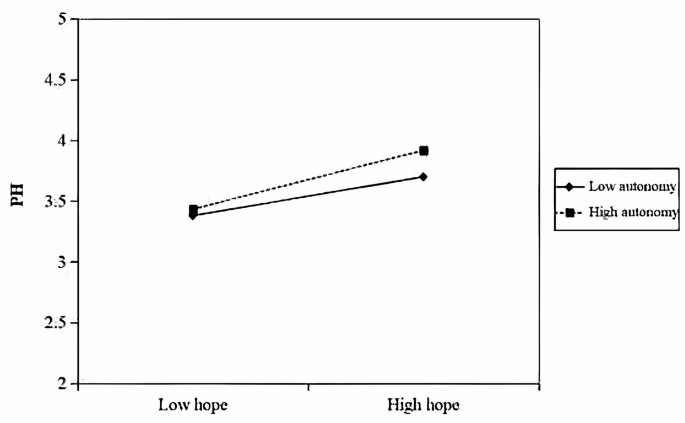
The linear moderating effect of autonomy on hope and psychosexual health. Note: PH = Psychosexual Health
Autonomy moderated the relationship between self-efficacy and psychosexual health. At low levels of autonomy (–1 SD), the positive effect of self-efficacy on psychosexual health was relatively weak (β = 0.250,p < 0.001). At the mean level of autonomy (0 SD), this effect increased (β = 0.342,p < 0.001), and it became notably stronger at high levels of autonomy (+ 1 SD) (β = 0.434,p < 0.001). These findings indicate that greater autonomy enhances the positive influence of self-efficacy on adolescents’ psychosexual health (Fig. 3).
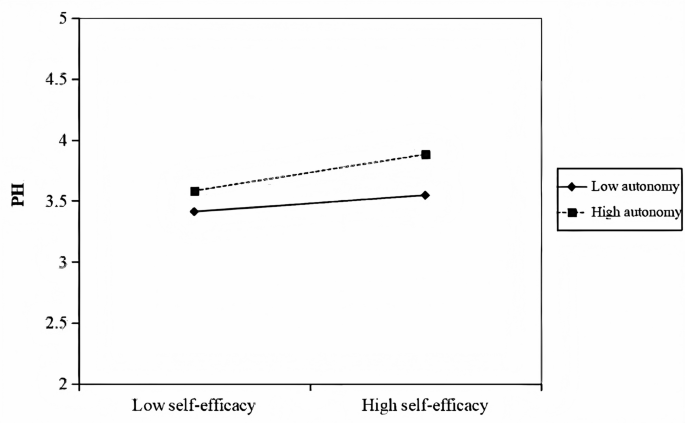
The linear moderating effect of autonomy on self-efficacy and psychosexual health. Note: PH = Psychosexual Health
Autonomy moderated the relationship between resilience and psychosexual health. When autonomy was low (–1 SD), the positive effect of resilience on psychosexual health was relatively modest (β = 0.210,p < 0.001). This effect became stronger at the mean level of autonomy (0 SD) (β = 0.310,p < 0.001), and it was further amplified under high autonomy conditions (+ 1 SD) (β = 0.411,p < 0.001). These results suggest that adolescents with higher levels of autonomy are better able to leverage their resilience to enhance their psychosexual well-being (Fig. 4).
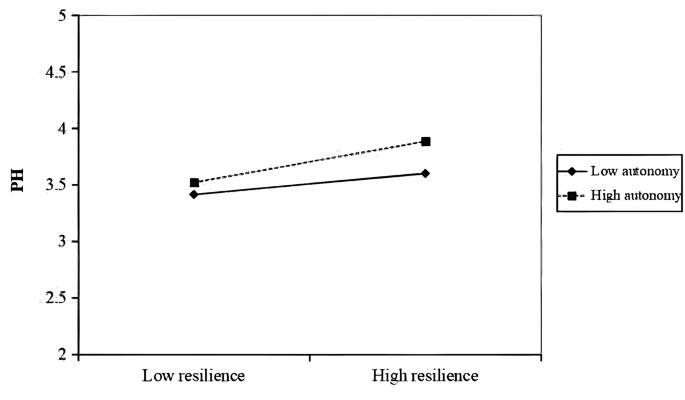
The linear moderating effect of autonomy on resilience and psychosexual health. Note: PH = Psychosexual Health
Autonomy moderated the relationship between optimism and psychosexual health. Under low autonomy, the positive effect of optimism on psychosexual health was weaker (β = 0.324, p < 0.001). This effect became stronger at the mean level of autonomy (0 SD) (β = 0.419,p < 0.001). However, under high autonomy, the effect was significantly stronger (β = 0.513, p < 0.001). These results suggest that higher autonomy amplifies the positive relationship between optimism and psychosexual health (Fig. 5).
In summary, the findings underscore the critical role of autonomy as a moderator, enhancing the positive effects of hope, self-efficacy, resilience, and optimism on psychosexual health.
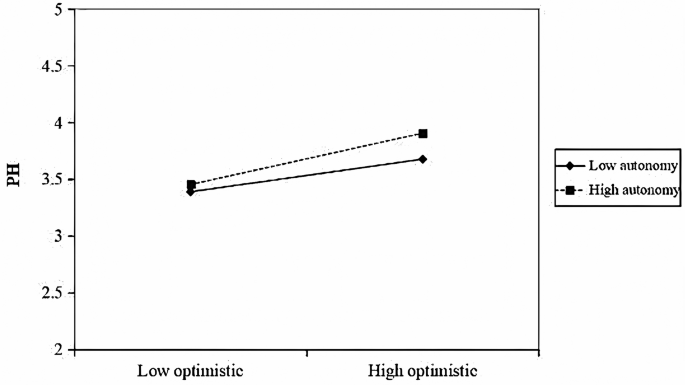
The linear moderating effect of autonomy on optimism and psychosexual health. Note: PH = Psychosexual Health
link