Boden, M. et al. Addressing the mental health impact of COVID-19 through population health. Clin. Psychol. Rev. 85, 102006 (2021).
Google Scholar
Lima, C. K. T. et al. The emotional impact of coronavirus 2019-nCoV (new coronavirus disease). Psychiatry Res. 287, 112915 (2020).
Google Scholar
Inchausti, F., MacBeth, A., Hasson-Ohayon, I. & Dimaggio, G. Psychological intervention and COVID-19: what we know so Far and what we can do. J. Contemp. Psychother. 50, 243–250 (2020).
Google Scholar
Yao, H., Chen, J-H. & Xu, Y-F. Patients with mental health disorders in the COVID-19 epidemic. (2020).
Hidese, S., Nogawa, S., Saito, K. & Kunugi, H. Food allergy is associated with depression and psychological distress: A web-based study in 11,876 Japanese. J. Affect. Disord. 245, 213–218 (2019).
Google Scholar
Choi, N. G., Sullivan, J. E., DiNitto, D. M. & Kunik, M. E. Associations between psychological distress and health-related behaviors among adults with chronic kidney disease. Prev. Med. 126, 105749 (2019).
Google Scholar
Teasdale, T. & Antal, K. Psychological distress and intelligence in young men. Pers. Indiv. Differ. 99, 336–339 (2016).
Shahyad, S. & Mohammadi, M. T. Psychological impacts of Covid-19 outbreak on mental health status of society individuals: a narrative review. J. Military Med. 22 (2), 184–192 (2020).
Taquet, M., Geddes, J. R., Husain, M., Luciano, S. & Harrison, P. J. 6-month neurological and psychiatric outcomes in 236 379 survivors of COVID-19: a retrospective cohort study using electronic health records. Lancet Psychiatry. 8 (5), 416–427 (2021).
Google Scholar
Yang, L. et al. Analysis of psychological state and clinical psychological intervention model of patients with COVID-19. MedRxiv 2020:2020.2003. 2022.20040899.
Mauro, C. et al. Prolonged grief disorder: clinical utility of ICD-11 diagnostic guidelines. Psychol. Med. 49 (5), 861–867 (2019).
Google Scholar
Dong, L. & Bouey, J. Public mental health crisis during COVID-19 pandemic, China. Emerg. Infect. Dis. 26 (7), 1616 (2020).
Google Scholar
Radfar, A., Ferreira, M. M., Sosa, J. P. & Filip, I. Emergent crisis of COVID-19 pandemic: mental health challenges and opportunities. Front. Psychiatry. 12, 631008 (2021).
Google Scholar
Hosseini, S., Esmati Moghaddam, M., Dehnokhalji, H., Soltani, R. & Mohammadi, A. The effect of mindfulness-based stress management training on anxiety and depression in female students. Q. J. Zool. Educational Sci. 2 (3), 65–73 (2016).
Shapiro, S. L., Carlson, L. E., Astin, J. A. & Freedman, B. Mechanisms of mindfulness. J. Clin. Psychol. 62 (3), 373–386 (2006).
Google Scholar
Siegel, R. D. The Mindful Solution: Everyday Practices for Everyday Problems (Guilford, New York, 2010).
Pourmohseni-Koluri, F. & Eslami, F. The effectiveness of group cognitive therapy based on mindfulness on mental health and quality of life of patients with irritable bowel syndrome. Health Psychol. 5 (20), 48–67 (2017).
Thurston, M. D., Goldin, P., Heimberg, R. & Gross, J. J. Self-views in social anxiety disorder: the impact of CBT versus MBSR. J. Anxiety Disord. 47, 83–90 (2017).
Google Scholar
Dahl, C. J., Lutz, A. & Davidson, R. J. Reconstructing and deconstructing the self: cognitive mechanisms in meditation practice. Trends Cogn. Sci. 19 (9), 515–523 (2015).
Google Scholar
Valikhani, A. & Yarmohammadi-Vasel, M. The relationship between attachment styles and death anxiety among cardiovascular patients. J. Kerman Univ. Med. Sci. 21 (4), 355–367 (2014).
Davidson, R. J. et al. Alterations in brain and immune function produced by mindfulness meditation. Psychosom. Med. 65 (4), 564–570 (2003).
Google Scholar
Banerjee, D., Kosagisharaf, J. R. & Rao, T. S. ‘The dual pandemic’of suicide and COVID-19: A biopsychosocial narrative of risks and prevention. Psychiatry Res. 113577. (2020).
Dalili, Z. & Bayazi, M. H. The effectiveness of mindfulness-based cognitive therapy on the illness perception and psychological symptoms in patients with rheumatoid arthritis. Complement. Ther. Clin. Pract. 34, 139–144 (2019).
Google Scholar
Omidvar, Z., Bayazi, M. H. & Faridhosseini, F. Comparing the effectiveness of mindfulness-based cognitive therapy training and cognitive-behavioral therapy on sexual satisfaction of women with vaginismus disorder. J. Fundamentals Mental Health. 23 (4), 267–271 (2021).
Safari, M., Teimoori, S., Bayazi, M. H. & Rajaee, A. Effectiveness of mindfulness interventions based on stress reduction on Parent-Child tension in parents of children with Attention-Deficit/Hyperactivity disorder. Razi J. Med. Sci. 30 (5), 154–162 (2023).
Othman, S. Y., Hassan, N. I. & Mohamed, A. M. Effectiveness of mindfulness-based interventions on burnout and self-compassion among critical care nurses caring for patients with COVID-19: a quasi-experimental study. BMC Nurs. 22 (1), 305 (2023).
Google Scholar
Wang, M. et al. Effects of a online brief modified mindfulness-based stress reduction therapy for anxiety among Chinese adults: A randomized clinical trial. J. Psychiatr. Res. 161, 27–33 (2023).
Google Scholar
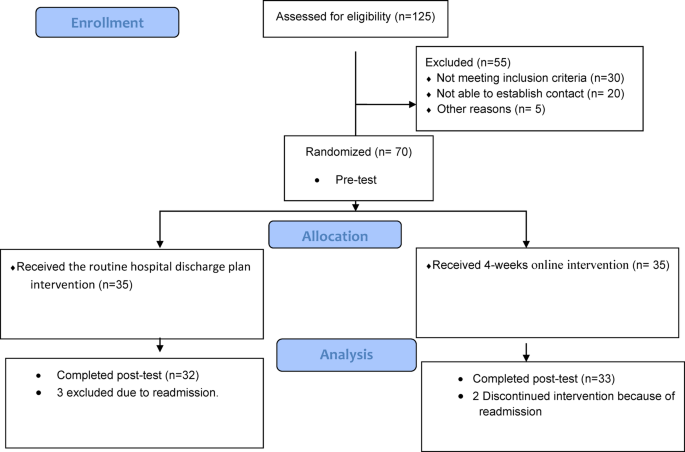
Schulz, K. F., Altman, D. G. & Moher, D. CONSORT 2010 statement: updated guidelines for reporting parallel group randomised trials. J. Pharmacol. Pharmacotherapeutics. 1 (2), 100–107 (2010).
Goldberg, S. B. et al. Mindfulness-based interventions for psychiatric disorders: A systematic review and meta-analysis. Clin. Psychol. Rev. 59, 52–60 (2018).
Google Scholar
Lovibond, P. F. & Lovibond, S. H. The structure of negative emotional states: comparison of the depression anxiety stress scales (DASS) with the Beck depression and anxiety inventories. Behav. Res. Ther. 33 (3), 335–343 (1995).
Google Scholar
Amico, K. R. Percent total attrition: A poor metric for study rigor in hosted intervention designs. Am. J. Public Health. 99 (9), 1567–1575 (2009).
Google Scholar
Kabat-Zinn, J. Mindfulness-based interventions in context: past, present, and future. (2003).
Shojaei, F. & Soltanizadeh, M. The effect of mindfulness-based stress reduction intervention on psychological flexibility, distress tolerance, and re-experiencing the trauma in veterans with post-traumatic stress disorder. Military Caring Sci. J. 4 (4), 236–248 (2017).
Cohen, J. Statistical Power Analysis for the Behavioral Sciences (Routledge, 2013).
Panting, A., Heise, A. G., Hechanova, M. R. M. & Waelde, L. C. Mindfulness interventions for disaster resilience in Southeast Asia. In: Resistance, Resilience, and Recovery from Disasters: Perspectives from Southeast Asia. edn. 95–108. (Emerald Publishing Limited, 2020).
Behan, C. The benefits of meditation and mindfulness practices during times of crisis such as COVID-19. Ir. J. Psychol. Med. 37 (4), 256–258 (2020).
Google Scholar
Milani, G. et al. Tele-Mindfulness program for mental health in previously hospitalized COVID-19 patients: A quasi-experimental study. Adv. Rehabilitation Sci. Pract. 13, 27536351241308176 (2024).
Sadooghiasl, A., Ghalenow, H. R., Mahinfar, K. & Hashemi, S. S. Effectiveness of mindfulness-based stress reduction program in improving mental well-being of patients with COVID-19: A randomized controlled trial. Indian J. Crit. Care Medicine: Peer-Reviewed Official Publication Indian Soc. Crit. Care Med. 26 (4), 439 (2022).
Google Scholar
Hatami, S., Khakpur, M. & Safarian Tosi, M. R. Comparing the effectiveness of Mindfulness-Based stress reduction group exercises and Emotion-Focused group therapy on psychological Well-Being of hospitalized patients recovered from Covid-19. Res. Clin. Psychol. Couns. 13 (1), 64–86 (2023).
Shahidi, S., Zargar, F., Khajelangi, H. A. & Tarrahi, M. J. The effect of internet-delivered mindfulness stress reduction combined with acceptance and commitment therapy on health anxiety and quality of life of caregiver of patients infected by COVID-19: A randomized clinical trial. Int. J. Community Based Nurs. Midwifery. 11 (2), 110 (2023).
Google Scholar
Cox, C. E. et al. Mobile Mindfulness Intervention for Psychological Distress among Intensive Care Unit Survivors: A Randomized Clinical Trial (JAMA internal medicine, 2024).
Simonsson, O., Bazin, O., Fisher, S. D. & Goldberg, S. B. Effects of an eight-week, online mindfulness program on anxiety and depression in university students during COVID-19: A randomized controlled trial. Psychiatry Res. 305, 114222 (2021).
Google Scholar
Dai, Z. et al. The association of mindfulness and psychological well-being among individuals who have recovered from COVID-19 in Jianghan district, wuhan, china: a cross-sectional study. J. Affect. Disord. 319, 437–445 (2022).
Google Scholar
Murray, G. et al. Online mindfulness-based intervention for late-stage bipolar disorder: pilot evidence for feasibility and effectiveness. J. Affect. Disord. 178, 46–51 (2015).
Google Scholar
Andersson, G., Cuijpers, P., Carlbring, P., Riper, H. & Hedman, E. Guided Internet-based vs. face‐to‐face cognitive behavior therapy for psychiatric and somatic disorders: a systematic review and meta‐analysis. World Psychiatry. 13 (3), 288–295 (2014).
Google Scholar
Merrigan, J. J. et al. Assessment of virtual mindfulness-based training for health care professionals: improved self-reported respiration rates, perceived stress, and resilience. Global Adv. Integr. Med. Health. 12, 27536130231187636 (2023).
Shah, K., Bedi, S., Onyeaka, H., Singh, R. & Chaudhari, G. The role of psychological first aid to support public mental health in the COVID-19 pandemic. Cureus 12(6). (2020).
link