Of the 16 participants in the feasibility study, 10 participants completed the post-assessment, and all 10 agreed to take part in the interview following their participation in the program. However, one participant called in sick and was not able to reschedule, leaving 9 participants for the interviews.
See Table 1 for participant characteristics. The sample included 3 men and 6 women with a mean age of 40.8 years, ranging from 28 to 65 years. All participants were intervention completers.
The thematic analysis resulted in three core themes capturing the participants’ experiences of change (see Table 2 for an overview). The first core theme, ‘perceiving change’, represents the specific changes the participants experienced, with four subthemes: 1a) being in control, 1b) feeling aware, 1c) accepting oneself and one’s emotions and 1d) gaining insight and knowledge. The second core theme, ‘supporting change’, captures factors that supported these changes, with five subthemes: 2a) acquiring skills, 2b) being in it together, 2c) therapist guidance, 2d) finding motivation, and 2e) putting it into practice. Finally, the third core theme, ‘sustaining change’, captures aspects important to maintain change, with two subthemes: 3a) working consistently, and 3b) giving it time. See Fig. 1 for a model illustrating how the core themes and subthemes are interrelated.
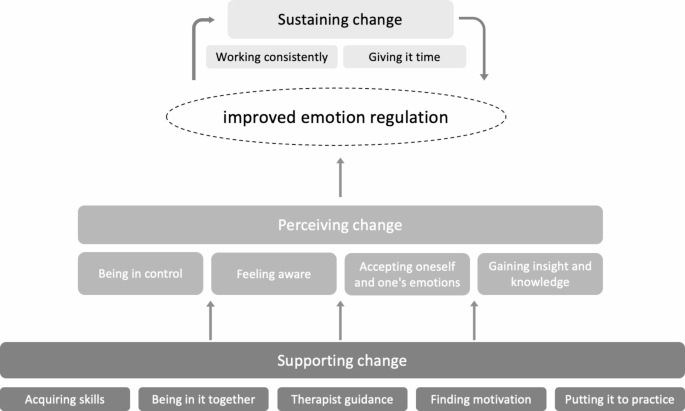
Model of change including core themes and subthemes
Theme 1: perceiving change
The first theme represents the participants’ experiences of change. Most of the participants described having undergone some kind of change following the intervention. The degree of change varied among the participants, with some participants also stating that they were uncertain whether they had experienced any change or said they would need more time to know whether they had changed. The changes were classified into the subthemes “being in control”, “feeling aware”, “accepting oneself and one’s emotions”, and “gaining insight and knowledge”.
Subtheme 1a: being in control
Several participants expressed an improved ability to control their emotions following their participation in the intervention. More emotional control also appeared to be related to feelings of calmness or emotional stability. This change was something that the participants themselves noticed, but also something others had observed. One participant said the following:
“I feel that I have more control over my emotions, or in a way, control over myself with emotions. My partner also says that she notices a change in that, I am much calmer, or that I am able to hold off a bit more, so she says it is starting to get better” (Participant 1).
In line with having more emotional control, some participants also expressed an improved ability to delay emotional reactions if they were not appropriate in a certain situation. At the same time, it was emphasized that they still acknowledged their emotions, and as such, it was different to suppressing, or pushing down, one’s emotions. One participant described:
“If I feel that it is not the right time for that reaction to come, then I can let it come and then just let it pass by, and then I can revisit it later, because, okay, it is not the right time now… But I must deal with them when the time is right because what I did before, was just to push them down and never bring them up again” (Participant 2).
One participant described that they previously assumed that their emotional responses were more fixed traits, whereas now they had learned that their emotions were more manageable, as illustrated by the following quote:
“I have noticed that I can, instead of jumping straight to a reaction, I can take some time to think about my reaction, and that is something I have done very little of in the past. Because I have been like: ‘I am probably just someone who reacts’, but then I have realized that you can change those patterns of behavior. Even if you have a certain personality type, you do not always have to act on the emotions that arise” (Participant 3).
Taken together, this subtheme illustrates how participants experienced changes that related to emotional control, including being able to inhibit emotional responses and experiencing their emotions as more manageable.
Subtheme 1b: feeling aware
In the interviews, several participants described an improved awareness of their emotions. It was further described that they were more present and able to be in the “here-and-now”. This kind of awareness was stated to be helpful when they were stressed or overwhelmed, by bringing their attention back to their emotions or their bodily sensations. They described that they would more frequently take pauses throughout the day to “check in” with themselves. One participant said:
“To my relief, I notice several times a day that I kind of, where are you now, what are you feeling now, what is happening now?” (Participant 4).
Several participants emphasized that they were more aware of their emotions, and they were better at identifying, recognizing, and labelling their emotions. One participant expressed:
“I am better at naming emotions, yes, or just being aware that they are there. That was important, that was something I benefitted from” (Participant 4).
Consistent with this, one participant described how they had become more aware what emotions they were feeling, as well as the difference between primary and secondary emotions, as illustrated by the following quote:
“Often a lot of emotions would be expressed as anger, especially towards the people that are close, because that was an emotion that I had more control over, but it was perhaps fear or sadness I was feeling, so I have become a bit more aware of that” (Participant 3).
In sum, this subtheme shows how participants experienced a higher awareness of their emotions, where they described an improved ability to notice and identify their emotional states.
Subtheme 1c: accepting oneself and one’s emotions
Acceptance seemed to be central in the participants’ accounts, including both self-acceptance and emotional acceptance. With this acceptance, the participants also seemed to have a higher tolerance or an improved ability to endure their emotions. One participant said:
“To sort of say, emotions are not dangerous, like, the emotion in itself is not dangerous, they are just there, right?” (Participant 2).
Rather than attempting to suppress or battle their emotions, the participants reported adopting a more accepting approach, where they allowed themselves to simply observe and acknowledge their emotions without judgment. One participant described:
“If I am in a negative position, then I kind of remind myself: “okay, why am I doing this, why do I feel this?” (Participant 1).
Some participants described an increased self-acceptance, accepting both positive and negative sides of themselves. They reported to be less self-judgmental and more forgiving of themselves or mistakes they had made. Accepting oneself also seemed to help with coping. One participant said:
“It seems almost paradoxical to accept something you wish you didn’t have. But I handle it better by accepting how it is” (Participant 4).
Taken together, this subtheme highlights how participants experienced an increased acceptance of themselves. The participants adopted a more accepting approach to their emotions, where they would observe and acknowledge their emotions, with less judgement.
Subtheme 1d: gaining insight and knowledge
Several participants reported to have gained insight, including insight about oneself, such as one’s own challenges and coping strategies, but also knowledge about ADHD, emotions, and emotion regulation strategies. One participant said:
“I have gotten more insight into how to deal with these things” (Participant 5).
The participants came into the intervention with varying degrees of knowledge and previous experiences. Some participants had been diagnosed with ADHD for a long time, and had previous experience with therapy, whereas others had just received the diagnosis. As such, some of the participants who had been diagnosed for a longer time expressed that they already had knowledge of the course material. In line with this, one participant described the following when asked about experienced changes:
“I use these kind of tools all the time. I did that before as well, but maybe I did not know that it was that I was doing, so it has been nice to become aware of what kind of tools I am actually using” (Participant 6).
One participant expressed how gaining insight into ADHD-related challenges helped her to understand that these challenges were not due to personal failings:
“It is not me as a person that is wrong or should have been different or something like that, but these are actual real problems that those with ADHD generally struggle more with than others” (Participant 7).
In sum, the participants reported to have gained more insight and knowledge following their participation, which appeared to be related to an improved understanding of themselves and their challenges.
Theme 2: supporting change
The second core theme centers around the elements that facilitated the changes the participants experienced. While the participants identified various factors that supported their process of change, it was also apparent that these same elements could hinder their progress if not applied effectively, or the same factors could be perceived as helpful by one participant, but unhelpful by another. The current theme was classified into five subthemes: “acquiring skills”, “being in it together”, “therapist guidance”, “l finding motivation” and “putting it into practice”.
Subtheme 2a: acquiring skills
Most participants highlighted the intervention’s specific content, such as the skills and psychoeducation, as key facilitators for change. Many emphasized the value of the stop / check-in skill, which encourages the participants to take regular pauses to check in with themselves, considering their emotions and thoughts, and making more mindful decisions. At the same time, there was notable variation in what specific tools or skills the participants found to be beneficial. Due to the heterogeneous nature of ADHD, the participants pointed to the importance of having a wide selection of skills. One participant said:
“We got some tools each time, and those tools, getting a lot of those emotion regulation tools, that has been very nice, because due to that, I was actually able to find a mindfulness skill that worked for me” (Participant 1).
Several participants stated they had been skeptical of parts of the intervention beforehand, especially the parts about mindfulness. In this regard, it was deemed as beneficial that the therapists underscored that it takes time to succeed and to not have unrealistic expectations. One participant said:
“The first time I tried it, I was like: “it probably won’t change much, but let’s give it a try”. But I actually felt quite an immediate response. So, there were several things that you could try that had better effects than I expected before trying them” (Participant 3).
Some participants also emphasized the importance of other content, such as psychoeducation or theories on emotions. For some, this contributed to new insight which again could lead to improved management of emotions, as described by the following quote:
“We talked a lot about, you know, what kind of person you want to be and the goals you want to set, and the choices you make and the actions you take being useful in reaching that goal. That has helped. For example, when I have had discussions with my partner or there have been situations where emotions tend to, you know, become difficult to control, then I have thought: ‘well it is not helpful if I say all of that now’, and that I need to think about it bit more, you know” (Participant 3).
At the same time, the skills and psychoeducation could also be experienced as a barrier by not being tailored to ADHD, or if one felt the skills were not relevant to oneself. For instance, one participant mentioned that they did not find the skills fitting for people with ADHD. This participant underscored that it is important that the content of the intervention is both specific and feasible for adults with ADHD to be helpful:
“I wonder if it perhaps was the skills that I did not think were tailored to us… because just having to, what was it, one of them was: “notice when you brush your teeth and feel every tooth” uh, and I do not have time for that’” (Participant 6).
To summarize, most of the participants found specific content or skills presented in the intervention as valuable. However, some also felt that the intervention content was not entirely relevant or tailored to ADHD.
Theme 2b: being in it together
The value of being together with other people with ADHD in a group seemed to be central in the participants’ experiences. Some participants highlighted this as the most important aspect of the intervention. The group’s real-life examples of living with ADHD seemed to color the content of the intervention and strengthen its connection to ADHD. Most of the participants reported to value the group discussions and being able to talk about their own experiences in a group with others who understood their challenges. One participant said the following:
“Something that made a huge difference was simply meeting like-minded people in a group, and the dialogue that unfolded from that, I would almost dare to say, that has been a gamebreaker for me” (Participant 8).
Meeting others with ADHD in this setting was reported to contribute to an experience of universality, which made the participants feel validated and less alone in their struggles. One participant said:
“You meet others in the same situation, and there can be this kind of belonging with such a group… That has a lot of value” (Participant 9).
Being in a group was reported to make the intervention more relatable, where the examples from other group members helped make the program more relatable to real life. Through the other participants, they would get examples of how the skills could be applied in everyday life. Some also expressed that being with others made it easier to learn. One participant said the following:
“I use some apps and such, but it still is not the same. If you can talk to others and they share experiences and tips and so on, it is a bit different. I think you learn much more from that than always trying to figure things out on your own” (Participant 9).
At the same time, the group could also present challenges. For example, some participants said it could be difficult to relate to the other group members at times, or it could be a challenge to be vulnerable in such a setting with new people. One participant also noted that the group could exaggerate their ADHD symptoms.
“When you’re around others who have ADHD, you talk about it, and you kind of, it’s like you sort of like some of the symptoms get intensified. It passes, in a way, but suddenly I found myself forgetting things and becoming distracted” (Participant 3).
Many participants expressed that there should have been more time for group interaction and peer discussions in the program, including discussions about the course content, but also about personal life experiences.
In summary, the other group members were highly important to most participants. The participants valued discussions with peers who understood their perspectives and shared similar experiences, making them feel less alone.
Subtheme 2c: therapist guidance
The third subtheme focuses on the role of the therapists. The therapists could both facilitate and hinder change, where a therapeutic match seemed to be crucial. It was emphasized that it was important to have therapists ‘who know what they are doing’. The therapists could be thought of as navigators, guiding the participants through the intervention, and ensuring they were on the right path. One participant said:
“The ones leading it, those who guided the conversation, they managed to keep it grounded. The insights they shared were valuable. There was a progression in it” (Participant 8).
Some participants expressed that it was helpful to have therapists that they could go to for advice and talk to if they needed help. The therapists seemed to offer a different perspective on things, which was valuable. One participant said:
“They were really good at it, those who facilitated it. They could, in a way, or at least I found it very helpful, that they always had a different, how can I say this, when I expected a yes or no answer, they always had another perspective in a way” (Participant 9).
At the same time, there could also be challenging aspects related to the therapists. For instance, one participant expressed that the therapists did not have enough understanding or compassion for their challenges, which made it difficult to be open:
“I felt a bit, in a way, not taken seriously when we tried to give examples of how intense it could be. We all read signals, right? So, once you get that feeling, well, yeah, nothing more comes out, yeah, we don’t open up much more” (Participant 6).
Some participants expressed that the therapists did not have lived experience with ADHD, which could make it difficult for the therapists to truly relate to the participants’ experiences. One participant said:
“If you are trying to understand someone else’s experience of something, it can be quite challenging at times… Like, you must have felt it in your body. That is how it is with all things; you cannot imagine what it is like to have a broken leg before you have broken it yourself” (Participant 8).
In accordance with this, it was suggested to involve someone with ADHD as group leader to provide personal examples on how to utilize the skills presented in the program.
In sum, the therapists were seen as navigators, offering insight and guidance throughout the course of the program. Having a therapist that showed compassion and understanding was important, where some participants emphasized that therapists without ADHD might struggle to understand the participants’ experiences.
Subtheme 2d: finding motivation
The fourth subtheme highlights how internal processes, such as motivation and willingness to engage in the process, were essential for positive outcomes. These were also aspects that could potentially hinder the therapeutic process. Several participants emphasized that it was difficult to maintain motivation throughout the program. One participant said:
“I lacked a bit of willpower towards the end” (Participant 1).
Some participants further expressed how taking part in psychological interventions, and especially in an intervention with an emphasis on emotions, could be demanding. As such, one had to be willing to engage, as participating in the intervention also had a cost. One participant said:
“It costs something to get into it. It costs to sit down and take a dive into something that might not be so comfortable” (Participant 7).
At the same time, it was underscored that perhaps it was these “uncomfortable” aspects that contributed to progress:
“There were things that I would not have thought about doing myself, that I thought, there and then was a bit “oh, that is uncomfortable” or “I cannot be bothered to” or “that sounds difficult” or something like that, but then it was actually quite useful, and it is perhaps those things I thought about most afterwards, that made me think in a slightly different way” (Participant 9).
Taken together, motivation was seen as crucial to achieve therapeutic change, but also as challenging to maintain throughout the intervention.
Subtheme 2e: putting it into practice
The last subtheme highlights that change requires practice of skills outside the therapy setting and in everyday life situations. Although this was deemed as highly important to make a change, most participants described the practice and implementation of skills into everyday life as difficult.
To be implemented in everyday life, it was important that the skills were perceived as relevant and useful. The participants expressed a great heterogeneity in their preferred skills, and some expressed that they had to adjust the skills to make them ‘work for them’. Moreover, a wide selection of skills that could be practiced ‘on the go’ were experienced as useful by the participants. One participant said the following:
“We had a lot of different skills and then there were things you could do in different ways. It was not like you had to sit down and breathe, you could practice when you were walking, driving or all kinds of things, and that makes it more accessible, then you do not have to set aside time, you can just do it wherever you are, so that has been nice” (Participant 3).
At the same time, it could be challenging to implement skills training in everyday life. Some participants pointed to ADHD-related challenges, such as problems getting started, inattention, or having a ‘wandering mind’, as reasons for not doing the skills training. The lack of skills training could also be related to the program itself, for instance, some participants pointed to unclear instructions of the skills or not finding the skills suitable for their needs. Other reasons included external events, such as having to prioritize work or family life. One participant said the following when asked about challenging aspects of the program:
“To do the tasks, or in a way keeping the program alive when you are not there. Because life gets you, with kids and activities and everything there is, and in a way setting aside time for it” (Participant 7).
The companion app, which was intended to help the participants with skills training in between the group sessions, could be experienced as both a facilitator and a barrier. With regard to helpful aspects, several participants found the combination of face-to-face and digital elements as useful, where each of the elements had its own value. In particular, the participants mentioned that it was helpful to have access to the skills via the app and to receive reminders on their phones. One participant said:
“We always received a message, which was good… it really helped me to remember because otherwise, I would have typically postponed it or forgotten, but now, I did it quite often after receiving the message” (Participant 9).
There were also challenging aspects related to the companion app. For instance, several participants struggled with the login procedure, as it required two-factor identification. This was highlighted as a barrier, where the login procedure to the app was deemed too complicated and time consuming. One participant said the following:
“I think one of the main reasons I used it (the companion app) so little was because it became burdensome, especially for a group like us, who are always short on time and tend to give up when faced with resistance” (Participant 6).
In sum, using the skills from the intervention in their everyday life was important for change. To facilitate this kind of implementation, it was essential that the skills were relevant and accessible.
Theme 3: sustaining change
The third core theme focuses on making the change last. It was emphasized that change was a continuous process which was not complete after the program had ended. This theme has two subthemes: “working consistently” and “giving it time”.
Subtheme 3a: working consistently
Several participants emphasized that to achieve and maintain change, it required consistent work, where repetition and continuous practice of the skills were necessary. It was also expressed that more work was required to obtain a lasting change. One participant said:
“A lot more work is needed, but at least I notice that it is going in the right direction” (Participant 2).
It was highlighted that maintaining change required a change in habits, where the skills needed to become integrated into their everyday life and routines. One participant said:
“You are essentially taking part in a lifestyle change to improve your well-being. So, you have to work on things more or less continuously” (Participant 5).
There were also some participants who expressed that they had not experienced any changes yet, and they would not know whether the program was effective until they had put down more work, as illustrated by the following quote:
“But if I notice a change, I mean, I believe that if it is going to have an effect, you have to continue with it” (Participant 9).
Taken together, participants highlighted that change required consistent work, where some also felt that more work was needed in order to benefit from the intervention.
Subtheme 3b: giving it time
Several participants expressed that these kinds of life changes take time and that they needed to continue with the program over time. Some participants felt that the length of the program was too short to achieve change within the timeframe. One participant said:
“I feel that eight weeks is a bit too short to establish new habits” (Participant 2).
To help maintain the effects of the program, one participant suggested that there could have been a type of “aftercare” following the end of the program or to allow the participants to retake the program after some time. One participant expressed:
“We could have had a group like that running for a long time, that it was continuous. I don’t know, I think it was, maybe not every week, but it is probably very useful for many to have something like that, a coach or, at least something similar” (Participant 9).
In line with this, it was also suggested to increase the number of group sessions or add more time to the sessions so that the participants had more time to repeat and discuss the content. One participant said:
“I wish there was more time, more time to go through things, more time for reflections around the tasks you were given or were about to get started on” (Participant 8).
In sum, this subtheme illustrates that change takes time. With regards to this, some felt more long-term support would have been beneficial to maintain change.
link