Overview
Recent data show that the United States is in mental health crisis, experienced by people of all ages. This trend was observed prior to the COVID-19 pandemic, but has been worsened by pandemic-related factors.
- One in five American adults experienced symptoms of anxiety and depression in 2023.1
- Even before the onset of the pandemic, there were noted increases in depression among Americans ages 12 and older.2
- From 2020 through 2023, nearly 1 in 10 Americans reported experiencing depression.3
- 5.8 million emergency department visits occurred in 2021 with mental, behavioral, and neurodevelopmental disorders as the primary diagnosis.4
In addition, deaths from drugs, alcohol, and suicide more than doubled between 2000 and 2017 and continue to rise.5 These deaths, often associated with mental distress, continue to impact families and communities socially, emotionally, and economically long after they occur.
Youth
Young people in the United States are particularly affected by the mental health crisis:
- Two in five high school students reported struggling with persistent feelings of sadness or hopelessness in 2023.6
- In the 10 years leading up to the COVID-19 pandemic, students’ persistent feelings of sadness and hopelessness increased by about 40% among high school students.7
- Youth and young adults (ages 10-24) account for 15% of all suicides, an increase of 52% since 2000. It is the second leading cause of death for this age group.8
What government is doing
The mental health crisis impacts families, communities, workplaces, and the economy. The highest levels of national leadership are working to address this issue in several ways:
- The White House has committed to a national strategy for addressing mental illness and substance use disorders.
- Many of the US Surgeon General’s current priorities revolve around mental health—including firearm violence, social connection, youth mental health, social media, health misinformation, workplace wellbeing, and health care worker burnout.
- Federal agencies under HHS—Substance Abuse and Mental Health Services Administration (SAMSHA) and Health Resources & Service Administration (HRSA)—are increasing access to treatment and services for:
- Those living with mental health conditions, including serious mental conditions that significantly interfere with the ability to carry out life’s activities.
- CDC plays a role in improving mental health through a public health approach, influencing conditions where people live, work, learn, and play (called the “social determinants of health”).
Improving mental health through public health
No one approach can solve the mental health crisis alone. CDC uses its expertise in public health data, science, and systems to improve mental health outcomes in the US.
- Public health uses a primary prevention approach to promote positive mental health by focusing on the drivers of well-being and mental distress. This approach aims to prevent mental health conditions before they develop or worsen.
- We identify, understand, and intervene on upstream protective factors, i.e., environmental and societal factors, to prevent mental distress and promote well-being for individuals and communities.
- We work with partners at the federal, state, and community level to improve mental health. These partners can include health care providers, public health workers, community organizations, faith-based communities, employers, local government leaders, and others.
CDC’s Mental Health Strategy builds on the Mental Health Framework created in partnership between CDC, the Association of State and Territorial Health Officials (ASTHO), Mental Health America (MHA), and the Center for Law and Social Policy (CLASP) in October 2023. The intent of the partner-developed Mental Health Framework is to help public health practitioners understand and communicate with multisector partners about their role in mental health promotion.
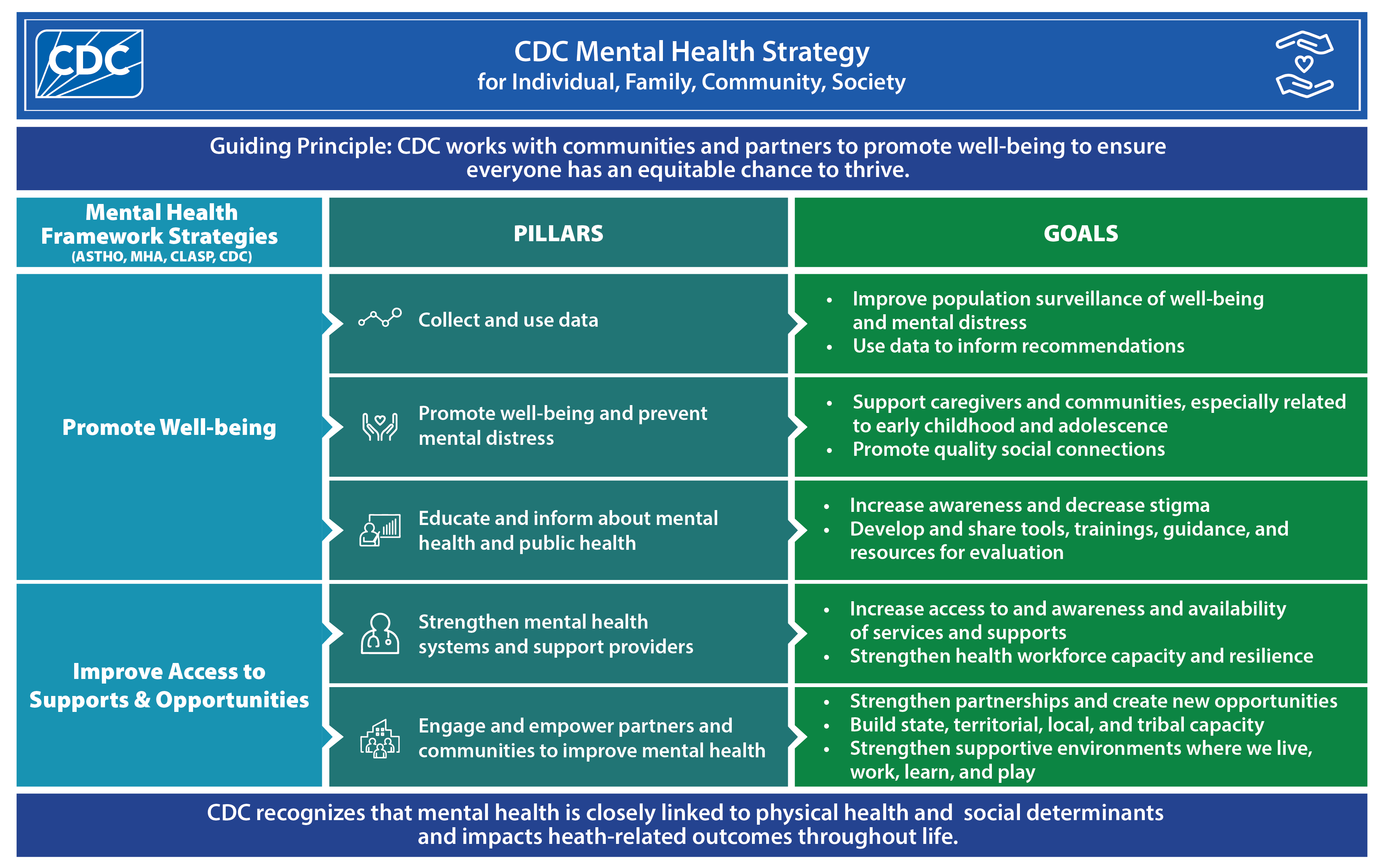
Health equity
CDC’s public health strategy to improve mental health is guided by principles of health equity. Health equity is the state in which everyone has a fair and just opportunity to attain their highest level of health.9 When people have limited access to resources they need to be healthy, such as access to health care, they are more likely to struggle with health issues.
CDC works with partners to promote policies and focus resources on improving the lives of populations disproportionately impacted by the mental health crisis. This includes a focus on addressing differences in social determinants of health to accelerate progress towards achieving health equity.
Disproportionately affected populations include:10
- Racial and ethnic minority groups, e.g., Black, Hispanic and Latino, American Indian/Alaska Native (AI/AN), Asian American, Native Hawaiian, and Pacific Islander (AA and NHPI)
- Lesbian, Gay, Bisexual, and Transgender, Queer, and Intersex (LGBTQI+)
- People experiencing homelessness
- People who are justice-involved
- People who live in rural areas
link