Characteristics of the included studies
Supplementary Table 1 contains the 19 studies analyzed in this review. The studies are listed in alphabetical order by the first author’s name, along with their main characteristics.
Study context and participants
Studies were conducted in Denmark31, Australia32, Germany33,34, Kosovo35, Norway36, and the United States37,38,39,40,41,42,43,44,45,46,47,48,49.
There was heterogeneity in terms of the type of CSS of the sample. Twelve studies assess and identify the specific type of CSS: fibromyalgia38,40,41,43, chronic urogenital pain or pelvic pain39,44,45, irritable bowel syndrome42,47, chronic back pain31,33, and headache46. Other included somatoform disorders or medically unexplained symptoms (mainly chronic pain)34,49, whiplash-related chronic pain32, and the remaining studies assessed general chronic pain without medical cause35,36,37,48.
Five studies31,32,34,35,37 also included the PTSD diagnostic criteria in their inclusion criteria, one study36 included patients who reported severe PTSD symptoms, and one study33 incorporated exposure to at least one psychologically traumatic event as part of its inclusion criteria. One study48 included war veterans with co-occurring general chronic pain, in which PTSS/PTSD was presumed due to the characteristics of the sample. The remaining studies38,39,40,41,42,43,44,45,46,47,49 did not directly assess PTSS/PTSD but reported a high percentage of traumatic events and/or suspected PTSS/PTSD related to the onset of pain syndromes.
The sample sizes across the studies varied widely, ranging from 26 to 230 participants. A total of 1504 participants were included in the systematic review. The weighted average age of the participants was 42.68 (11.59) years. In terms of sex distribution, a majority of the studies (n = 14) included both male and female participants, four studies38,39,44,45 included exclusively female participants, and one study41 did not specify the sex distribution of the sample. The total percentage of females in the sample was 82.70%, taking into account that four studies had missing data.
Treatments
The majority of the therapies applied in the experimental conditions can be classified into three general categories: pain-focused cognitive-behavioral therapy (P-CBT)32,34,35,36,37; written emotional disclosure (WED)38,40,42,44; and emotional awareness and expression therapy (EAET)39,41,43,46,47,48,49. The remaining studies differed widely in terms of treatment approaches. One study33 used pain-focused eye movement desensitization and reprocessing therapy (P-EMDR), other study31 applied somatic experiencing (SE) therapy, and one study45 applied interpersonal psychotherapy for pain (IPT-P).
Methodological characteristics
All the studies were randomized controlled trials, except one34, which was nonrandomized. Many studies have provided incomplete information regarding the protocol of the treatment applied. The duration of therapy ranged from 3 to 36 weeks, with total therapy hours varying from 1.5 to 28 h distributed across 3 to 20 sessions. Almost all session frequencies were weekly and applied in group-based43,47, individual48,49, or mixed35 formats.
The active control comparison conditions consisted of pain-focused cognitive-behavioral therapy (P-CBT)14,48, written positive emotional experience44, fibromyalgia-education (FM-E)43, and relaxation training (RT)46,47. Passive control conditions consisted of a waitlist (WL) control group32,35,36,46,47, treatment as usual (TAU)31,33,34,38,39,41,45,49, neutral written (NW)38,40,42, and minimum contact comparison group (MCC)37. It is to interest to note that four studies38,43,46,47 were three-arm controlled trials.
A first follow-up assessment was performed in all the studies, within a time frame ranging from 2 weeks to 12 months. A second follow-up assessment was conducted in six studies35,38,40,42,45,47 within a time frame ranging from 3 to 24 months. Two studies35,45 performed a third follow-up assessment at 9 months and at 36 months.
Risk of bias in studies
A summary of the risk of bias assessment for each included study is provided in Supplementary Fig. 1. Concerns about bias were identified in 42% of the studies (n = 8), five of which showed a high risk of bias33,34,37,42,45.
None of the studies included in this systematic review evaluated patients with a comorbid diagnosis of a specific CSS and PTSD. Only Kruse et al.34 evaluated patients with somatoform disorders (mainly pain) and PTSD according to the DSM-IV criteria. Somatoform disorders involves an experience of physical symptoms without a clear physical cause that when it consists of pain, it is indistinguishable from CSS4.
Result of syntheses
Pain
For the analysis of this outcome, we considered only the severity of pain. Four studies did not analyze this component34,44,45,47. Ten studies showed an improvement in pain in the experimental group31,37,38,39,40,41,43,46,48,49. Notably, all the studies evaluating trauma-focused therapy in CSS patients38,39,40,41,43,46,49 reported positive pain outcomes, except for one42. Three studies compared treatment with an active control condition. Lumley et al.43 found no differences between EAET and P-CBT but did find a significant difference between EAET and FM-E. Slavin-Spenny et al.46 reported no difference between AAET and RT, and Yarns et al.48 reported a significant difference between EAET and P-CBT. Among the passive control conditions, five studies showed significant differences between groups: Broderick et al.38 compared WED with TAU and NW; Carty et al.39 compared EAET-I with TAU; Hsu et al.41 compared ASA with TAU; Slavin-Spenny et al.46 compared AAET with WL; and Ziadni et al.49 compared EAET with TAU. Three studies did not find differences between groups: Andersen et al.31 compared SE with TAU; Beck et al.37 compared GCBT with MCC; and Gillis et al.40 compared WED with NW.
PTSS/PTSD
Six studies evaluated PTSS/PTSD31,32,34,35,36,37, and all of which reported improvement in PTSS/PTSD, except for one36 that found no changes. The samples of the studies consisted of war torture victims35, war refugees36, individuals with chronic pain (whiplash) related to a vehicle accident32,37, individuals with low back pain31 and patients with somatoform disorders34. All the treatments applied were trauma-focused therapies (SE31, TF-CBT32, TFP34, IT35, TRT36, GCBT37) and were compared with a passive control condition (TAU31,34, WL32,35,36, MCC37).
Anxiety and depression
Eleven studies have assessed anxiety and depression32,35,37,38,39,43,45,46,47,48,49. Pain diagnostics were CSS38,39,43,45,46,47,48,49, and generalized chronic pain32,35,37. All the studies applied trauma-focused therapies, except for one45 that applied pain-focused therapy. All the studies reported a decrease in anxiety and depression, except for one39 that found no changes. However, among passive control conditions, three studies35,38,47 showed significant differences that were not maintained at follow-up. When compared with active control conditions, Lumley et al.43 found no significant difference between EAET and P-CBT, but EAET differed significantly from FM-E; Thakur et al.47 showed a nonsignificant difference between EAET and RT; Slavin-Spenny et al.46 did not find differences between AAET and RT; and Yarns et al.48 observed a significant reduction in anxiety but not in depression, in EAET compared to P-CBT conditions, at posttreatment, although the differences becomes non-significant at follow-up .
Sleep and fatigue
Two studies assessed fatigue symptoms, and both analyzed the efficacy of trauma-focused therapy in patients with fibromyalgia. Gillis et al.40 observed a not statistically significant reduction in fatigue in WED condition compared with NW condition. Lumley et al.43 reported no differences between EAET and P-CBT, but compared to FM-E, treatment resulted in a significantly lower fatigue score.
Three studies evaluated sleep outcomes38,41,43, and all of which applied trauma-focused therapy (GCBT38, ASA41, EAET43) to patients with fibromyalgia. The results suggested that treatment had a positive effect on sleep quality compared to MCC38, TAU41 and FM-E43 control conditions, but the effect size appeared to be small, and there was no additional benefit compared with pain-focused therapy (P-CBT43).
CSS symptoms
Two studies assessed CSS symptoms, and both examined the efficacy of trauma-focused therapies in patients with irritable bowel syndrome. Thakur et al.47 reported a positive effect of EAET treatment compared to WL passive condition, but the effect size was small and did not differ from the active RT treatment. Laird and Stanton42 did not find a significant difference in CSS symptoms between WED and NW groups; however, statistically significant small-to-medium sized effects were observed over time across groups.
Quality of life
Three studies assessed quality of life, all of which examined the efficacy of trauma-focused therapies in patients with CSS. Broderick et al.38 reported no significant difference of the WED condition compared to the NW passive condition. Thakur et al.47 found a significant difference between EAET treatment compared to WL passive condition, but not compared to the RT condition. Laird and Stanton42 did not observe significant difference between WED condition compared to the NW passive condition; although the quality of life increased over time in both groups.
Meta-analysis
For the quantitative synthesis of the results, studies using the same instruments were selected. The measures considered were pain (Brief Pain Inventory, BPI50) and emotional distress (Brief Symptom Inventory, BSI51).
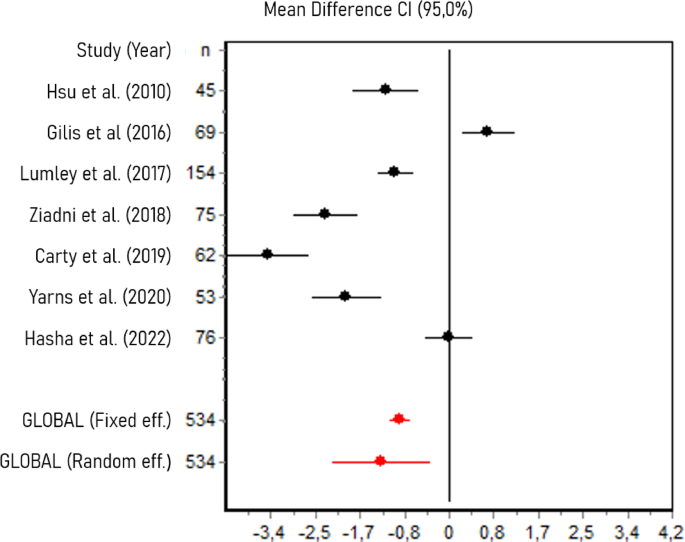
For pain, seven studies were included36,39,40,41,43,48,49, and for emotional distress, four studies were included39,46,47,49. The Dersemonian and Laird Q tests revealed heterogeneity in both variables, Q (x2) = 131.93, p = 0.000, and Q (x2) = 151.66, p = 0.000, respectively, leading to the adoption of a random-effects model. A significant and large overall effect of psychological treatment was observed for both pain (d = − 1.29, 95% CI − 2.22; − 0.36) and emotional distress (d = − 0.95, 95% CI − 2.86; 0.97). In the domain of pain, the study by Carty et al.39 comparing the EAET-Interview (EAET-I) with the TAU showed the largest effect size (d = − 3.45, large effect). Conversely, for emotional distress, the study by Ziadni et al.49, comparing the EAET-I with the TAU, exhibited the largest effect size (d = − 3.02, large effect) (Figs. 1 and 2, and Table 1).

Forest plot of pain scores for studies applying trauma-focused therapies. Note Negative sign indicates improvement.

Forest plot of emotional distress scores for studies applying trauma-focused therapies. Note Negative sign indicates improvement.
Sensitivity analysis showed that removing any of the studies did not impact the overall direction of the effect for the analyzed variables (Table 2), although the magnitude was slightly affected. For pain, Begg’s test (z = 1.50, p = 0.133) and Egger’s test (t = − 1.38, p = 0.225) indicated the absence of publication bias, but for emotional distress Begg’s test (z = 1.70, p = 0.090) and Egger’s test (t = − 17.99, p = 0.003) suggested the presence of publication bias.
link