The study was preregistered on 21st November 2022: https://aspredicted.org/9fy2-3fyd.pdf.
Participants
We recruited six samples through the Marketing Science Institute recruitment company as part of the International Climate Psychology Collaboration (ICPC)3,4. Country selection was based on increasing diversity relative to much research34 and the research experience and linguistic expertise of the research team. Samples were recruited to be representative of gender and age distributions in each country (Bulgaria, Greece, Nigeria, Sweden, UK, USA). Participants who failed an attention check at the very start of the survey were immediately excluded and replaced with another participant. The following numbers of unique participants completed the first, ICPC part of the study: Bulgaria: 792, Greece: 827, Nigeria: 1528, Sweden: 2502, UK: 964, USA: 880. Of these, participants who failed a second attention check later in the study or did not correctly complete the WEPT demo were excluded by the ICPC based on preregistered criteria3 (Bulgaria: 20, Greece: 149, Nigeria: 53, Sweden: 147, UK: 23, USA: 58). Unfortunately, a technical issue with the Greek version of the survey meant 532 participants were excluded as information about the nature of the study was visible before the PEET. The number of eligible participants who reached the PEET experiment [against preregistered recruitment aims] was—Bulgaria: 727 [500], Greece: 146 [500], Nigeria: 1346 [1000], Sweden: 2056 [1500], UK: 856 [500], USA: 735 [500].
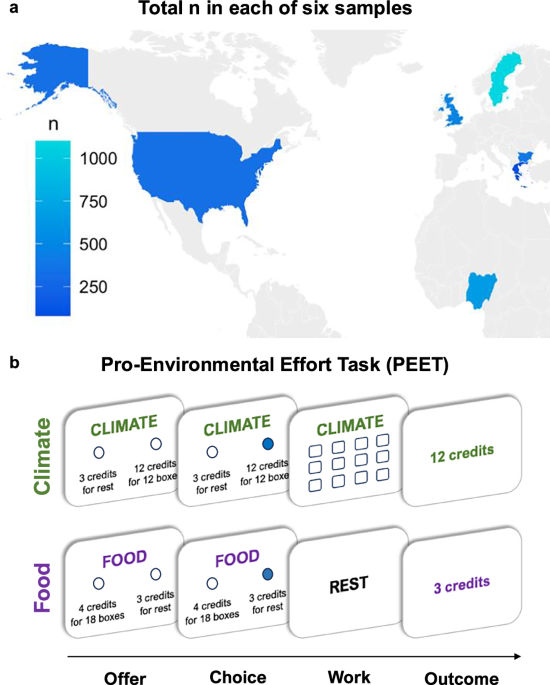
After receiving instructions about the PEET, participants completed two comprehension questions. If answered incorrectly, they saw reminders of the key aspects of the task and answered the questions again. As preregistered, we excluded participants who answered both questions incorrectly on the second attempt (Bulgaria: 82, Greece: 15, Nigeria: 191, Sweden: 305, UK: 145, USA: 149). We also excluded participants who missed more than 20% of trials in the PEET, in-line with our preregistration. While this resulted in a relatively large number of exclusions (Bulgaria: 241, Greece: 46, Nigeria: 495, Sweden: 661, UK: 229, USA: 252), it is important to ensure enough trials for analysis and because missing multiple trials could indicate a lack of engagement with the task. Therefore, the final analysis included a total of 3055 participants across six samples from Bulgaria: n = 404 (age 18–72, mean = 41.73, 195 female, 206 male, 3 other/unknown gender), Greece: n = 85 (age 19–61, mean = 37.05, 41 female, 43 male, 1 other/unknown gender), Nigeria: n = 660 (age 18–68, mean = 32.27, 259 female, 401 male), Sweden: n = 1090 (age 18–74, mean = 42.84, 567 female, 512 male, 11 other/unknown gender), UK: n = 482 (age 18–74, mean = 47.96, 270 female, 211 male, 1 other/unknown gender), USA: n = 334 (age 19–74, mean = 47.78, 197 female, 135 male, 2 other/unknown gender; Fig. 1a). All participants provided informed consent and the study was approved by the following ethics review boards: University of Birmingham Science, Technology, Engineering and Mathematics (STEM) Ethics Committee (20-1897PA); The Ethics Committee of the Faculty of Business, Economics and Social Sciences of the University of Bern (232022); and University of Crete Research Ethics Committee (7875342DoPSS).

a Participants from six countries across three continents completed the ICPC survey and the PEET: Bulgaria, Greece, Nigeria, Sweden, UK, USA. After applying preregistered exclusion criteria, across the six samples a total of 3055 participants were included in the analysis. b In the PEET, participants decide whether to exert effort for varying amounts of reward in the form of credits. Importantly, the credits obtained were real donations for two different charities—in half of the trials, the charity was climate-related (climate trials, top panel), and in the other half, it was non-climate related (food trials, bottom panel). Each trial started with a screen indicating the condition and the options—rest (no effort) for 3 credits and a work offer, associated with higher reward (4, 12, or 20 credits) for higher effort (50, 65, 80, or 95% of the boxes clicked in a calibration phase). Participants had 4 s to make a choice. If the work offer is chosen (top panel), participants need to click the specific number of boxes required to obtain the credits on offer in 10 s. If the rest option is chosen (bottom panel), participants rest for 10 s. Finally, the number of credits earned is displayed for one second, with zero credits earned following work choices but unsuccessfully meeting the required effort and following missed trials.
Task and measures
Pro-environmental effort task (PEET)
Participants decided whether to exert physical effort to earn money for a climate charity and a control food charity (Fig. 1B). Effort was quantified as clicking on-screen boxes. Before any instructions or information about the task, participants were prompted to click as many boxes as they could (of a maximum of 40) in 10 s. Participants then repeated this with encouragement to click even more boxes. The highest number across these two thresholding rounds was set as participants’ maximum number of boxes used to threshold the effort levels throughout the experiment, with 13 boxes as the lowest maximum threshold. Next, participants read instructions about the PEET and completed five practice trials: four non-decision practice trials performing each effort level (i.e., 50, 65, 80, or 95% of their thresholded maximum number of boxes), and one decision trial identical to the ones in the main task. Finally, participants answered two comprehension questions about the task. If they answered either of these questions wrong, they received key information again and answered the same comprehension questions a second time.
On each trial, participants chose between a no-effort, low-reward (3 credits) “rest” option and a “work” offer with variable higher effort (50, 65, 80, or 95% of maximum effort) and higher reward (4, 12, or 20 credits). If they chose to work, the participant had to exert the required effort, i.e., clicking the indicated number of boxes within 10 s. If participants did so, they obtained the number of credits available. If they failed to do so, they did not get any credits for that trial. If participants chose the rest option, they rested for 10 s and obtained 3 credits. Participants had four seconds to select the work or rest option. If they did not, they had to wait 10 s with no credits obtained for that trial. The visual location of the work and the rest options was counterbalanced on the left or right side of the screen across trials.
Participants completed 24 trials in total, presented in a randomized order. For half of the trials, credits were for a climate charity, and the other half of trials could benefit a control, non-climate-relevant food charity. The descriptions of these charities were tightly matched, both endorsed by the United Nations, with the climate charity described as an organization that “prevents climate change by reducing carbon emissions,” while the food charity “prevents starvation by providing food”. Credits were converted into donations at the end of the study and made to the two charities.
Work for environmental protection task (WEPT)27
In the modified version of this task, participants made up to eight decisions of whether to screen a page of numerical stimuli for specific features (even first digit, odd second digit). Each completed page led to a tree being planted via donations to tree-planting organization. Participants were first exposed to a demonstration of the WEPT, identifying all target numbers with an even first digit and odd second digit. They then read information stating that planting trees is one of the best ways to combat climate change and that they would have the opportunity to plant up to eight trees if they chose to engage in additional pages of the task (one tree per completed page). Each page contained 60 numbers to screen for target numbers and displayed icons of eight trees, one of which was coloured green to mark their progress in the task. Participants were allowed to exit the task at any point.
Climate beliefs3
Participants rated four items in terms of “How accurate do you think these statements are?” (0 = not at all accurate to 100 = extremely accurate): “Taking action to fight climate change is necessary to avoid a global catastrophe”, “Human activities are causing climate change”, “Climate change poses a serious threat to humanity” and “Climate change is a global emergency”. The measure had high internal consistency in the large ICPC sample3,4 (Cronbach’s alpha = 0.93, n = 59,440) and in the participants included in our analysis (Cronbach’s alpha = 0.94, n = 3055).
Climate policy support3
Participants rated their level of agreement with nine statements (0=not at all to 100=very much so) on support for specific climate policies: “I support…” “…raising carbon taxes on gas/fossil fuels/coal”, “significantly expanding infrastructure for public transportation”, “increasing the number of charging stations for electric vehicles, “increasing the use of sustainable energy such as wind and solar energy”, “increasing taxes on airline companies to offset carbon emissions”, “protecting forested and land areas”, “investing more in green jobs and businesses”, “laws to keep waterways and oceans clean”, and “increasing taxes on carbon intense foods (for example meat and dairy)”. The internal consistency in the large ICPC sample3,4 and the sample presented here was high (Cronbach’s alpha = 0.88, n = 59,440; Cronbach’s alpha = 0.89, n = 3055).
Subjective effort ratings (NASA Task Load Index35)
Participants answered two questions asking how effortful they found the easiest and the hardest levels of effort using a 0–100 Likert scale.
The Apathy Motivation Index (AMI)36
Participants answered the 18 questions of the AMI, indicating their level of agreement with each statement. This scale comprises three subscales/domains of apathy: behavioural activation, emotional sensitivity, and social motivation.
Interventions
Working-together norms
Participants read a flier promoting climate action as a collective effort, reinforcing the idea of working together with others to reduce carbon emissions.
System justification
Text and images framed climate change as a threat to participants’ way of life and encouraged pro-environmental behaviour as patriotic.
Binding moral foundations
Participants read a message invoking national pride, loyalty, and authority to support clean energy and climate action.
Exposure to effective collective action
Participants were shown examples of successful climate-related movements to inspire hope and belief in the power of collective action.
Future self-continuity
Participants imagined a future version of themselves and wrote a letter to their present self about the importance of taking climate action now.
Scientific consensus
Participants saw a message and graphic emphasizing that 99% of climate scientists agree climate change is real and caused by humans.
Decreasing psychological distance
Climate change was presented as an immediate, local threat, and participants reflected on how it affects them personally.
Dynamic social norms
Participants read that more people are taking climate action globally over time, supported by examples and data showing behavioural trends.
Correcting pluralistic ignorance
Participants were shown how concern about climate change is much more widespread than people typically believe.
Letter to future generations
Participants wrote a letter to a future child or other family member, describing their efforts to protect the planet and how they wish to be remembered.
Negative emotion
Participants were exposed to emotionally intense, alarming climate information designed to induce negative emotions.
Control group
Participants read a neutral passage of text not related to climate change from Great Expectations.
Procedure
All participants completed the experiment online via Qualtrics as part of the ICPC. For details of the ICPC collaboration procedure, intervention selection process, dataset, and results, see Vlasceanu, Doell, Bak-Coleman et al.3 and Doell, Todorova, Vlasceanu et al.4. At the start of the study, participants saw a specific definition of climate change and were randomly assigned to one of 12 groups. In the control, no-intervention group, participants were exposed to non-climate content (passage of text from Great Expectations by Charles Dickens). In the other 11 groups, participants were exposed to an intervention crowd-sourced from academic experts (also see Supplementary Table 1 describing each intervention). Next, all participants answered a series of questions on their climate beliefs, climate policy support, willingness to share climate information (with the order of these three measures randomized between participants), then a modified version of the Work for Environmental Protection Task27 (WEPT), and demographic information. The sample reported here from Bulgaria, Greece, Nigeria, Sweden, UK, and USA then completed the PEET, NASA ratings of subjective effort, and AMI (see above). The whole protocol, including the ICPC survey and the PEET with related measures, took approximately 30 min and was presented in the native language of each country, with English as an alternative language option.
Statistics and reproducibility
We used R37 (version 3.6.2) with R Studio38 (version 1.4.1106) for analysis following our preregistered analysis plan. In line with our pre-registration, we analysed behavioural choice data and computational model parameters (see below and Supplementary Methods for full modelling information) with (generalized) linear mixed-effects models (LMM; glmer/lmer function; lme4 package39 v1.1-27.1). Normality and equal variances were not formally tested as these models do not require data to strictly meet such assumptions, and the nature of the models account for the distribution of the data. Binomial GLMMs predicting people’s decision to accept the high-effort high-reward work offer included within-subject fixed effects of reward available (level 2–4: 4, 12, 20 credits), effort required (level 2–5: 50, 65, 80, 95% maximum), and cause (climate vs. food). Random effects were grouped by participant nested in country and removed when necessary to obtain a converging model that maximizes power while minimizing Type I errors40. A fixed between-subject effect of intervention group and interaction between intervention and cause (climate / food) was then added to this model, making the final model:
$$ \sim {}+{{{\rm}}}+{{{{\rm{cause}}}}}^{* }{{{\rm{intervention}}}}\\ +(0+{{{\rm{effort}}}}+{{{\rm{reward}}}}\, {||}\, {{{\rm{country}}}}/{{{\rm{participant}}}})\\ +(1+{{{\rm{agent}}}}\, {||}\, {{{\rm{participant}}}}:{{{\rm{country}}}})$$
Models of computational discounting parameters (Κ) had fixed effects of charity (climate/food) and intervention (control group and 11 interventions), and a subject-level random intercept, as there is only one datapoint per participant per charity. The GLMMs of Κs used a gamma distribution with log link function to account for the nature of the data without transforming raw values. Analysis of β parameters used an LMM, and choices to exert effort on the WEPT were analysed with cumulative link mixed models as previously41, each with a fixed effect of intervention and subject-level random intercept. In all models, intervention was coded using treatment contrasts to compare each intervention to the control group reference, whereas cause was coded using sum-to-zero contrasts. Continuous variables were mean-centred. We applied a significance threshold of p < 0.05 for all fixed parameters in the models. We used the parameters package42 (v0.18.1; model_parameters function) to extract standardized model coefficients (exponentiated in GLMMs to generate odds ratios for choices and mean ratios for Κ parameters), their standard errors, and 95% confidence intervals. Bayes factors were calculated using the BayesFactor package (v 0.9.12-4.7; ttestBF function with default priors).
Computational modelling
We quantified discounting of reward by effort (Κ) and decision consistency (inverse stochasticity β parameter) by comparing multiple models that represent different plausible theories of discounting. All models had two, cause-specific parameters for discounting (2Κ: Κclimate and Κfood) but varied in whether a single or two consistency β parameters applied across causes (1β or 2β). We also varied whether the shape of the discount function was linear, hyperbolic, or parabolic11, creating a total of six models (see Supplementary Methods). Models were fitted to the choice data using an iterative maximum a posteriori (MAP) approach as previously applied43,44,45, implemented in MATLAB (2019b, The MathWorks Inc). See Supplementary Methods for full details of the MAP approach. All code for model fitting and simulations can be found at Fitting the data across intervention groups using this method provides the most conservative comparison and is more robust to the influence of outliers than single-step maximum likelihood estimation46. It is therefore recommended over single step methods, where it is possible to implement46.
Model identifiability and parameter recovery
We used simulated data to establish that the model comparison procedure could correctly choose the best model and that parameters could be accurately estimated from our 24 trial schedule47,48. For model identifiability, we simulated data for 100 artificial agents based on each of the six models, drawing parameters randomly from a flat distribution between an upper and a lower bound covering all possible Κ parameter values for that model (0 < Κ<1 for linear, 0 < Κ<2 for parabolic) and 0<β < 10. Simulating ten datasets from each model and fitting each with the MAP approach and comparison procedure above generated confusion matrices showing the number of times the model was selected as best, based on exceedance probability. For parameter recovery, we simulated data using a grid of values covering the full ranges of the three parameters (Κclimate, Κfood, β) in the winning model across 176 simulated agents (Κ: 0, 0.3, 0.6, 0.9; β: integers 0–10) all with added noise drawn from a normal distribution * 0.05). As with model identifiability, we fit the simulated data using the MAP approach applied to data from the participants and created a confusion matrix of the correlations between simulated and fitted parameter values.
Reporting summary
Further information on research design is available in the Nature Portfolio Reporting Summary linked to this article.
link